Industry guides · Medical & Health · Updated November 2026
Patients now arrive informed. The practice of 2030 is ready for them.
Picture your practice four years from now. A nervous patient reads about a treatment at midnight and finds clear, honest answers from you, not a forum. They book a consultation without a phone call. Notes write themselves while the doctor listens. Recalls, aftercare and follow-ups go out on their own. The rooms stay full, and the team goes home on time. Every part of that exists today. This guide shows where healthcare stands, what is changing, and how to build that practice now.
Where the industry stands
Six changes reshaping private practice.
Healthcare moves carefully, and it should. But these changes have already started, and patients are moving faster than most practices. Each one is sourced and dated below.
Patients
One in four adults already asks AI about their health.
A West Health–Gallup survey of more than 5,500 US adults found that one in four use AI tools for health advice, and most of them do it before or after seeing a doctor. Patients arrive with questions already formed.1
The consulting room
Doctors are correcting what AI told their patients.
In a 2026 Zocdoc survey, 83% of doctors said they had to correct information patients brought from AI, and more than one in five patients admitted hiding their AI use. The practice that gives patients good answers first earns their trust.2
Claude for Healthcare
Frontier AI is now built for clinical settings.
In January 2026 Anthropic launched Claude for Healthcare: HIPAA-ready tools for providers, payers and health-tech companies, with opt-in connections to medical coding and coverage data. Anthropic says it does not train its models on users’ health data.3,4
Documentation
AI scribes are spreading, and need a careful eye.
Ambient AI scribes went from 20% to 29% of surveyed US physicians in a year. Results vary: UK GPs reported less time on notes and a lighter cognitive load, but nearly a third reported frequent errors. The note still needs a clinician’s review.5,6
The law
Health data is special personal information.
Under POPIA, information about a person’s health is special personal information, with stricter rules on who may process it and why. Every booking form, chatbot and email that touches a patient falls under it.7
The profession
AI does not change the ethical rules.
The HPCSA’s rules on advertising, canvassing and touting still apply online, and practitioners remain responsible for misleading content even when AI wrote it. Its social media guidance (Booklet 16) was updated in March 2025.8,9
What it means for your practice
Trust is decided before the first appointment.
Patients do not choose a doctor or a clinic the way they choose a product. They are weighing safety, credibility and how they will feel, usually alone and often late at night. Today many of them ask an AI first. If your practice is not the clear, calm answer they find, someone else becomes their first impression.
At the same time, the work behind the scenes is changing. Notes, coding, recalls and reminders are becoming assisted tasks. Done well, that gives clinicians time back. Done carelessly, it creates risk with the most sensitive information there is.
The practices that win the next five years will do both: become the trusted answer before the patient walks in, and use AI behind the scenes with the care the profession demands.
Picture it
A day in the practice of 2030.
Nothing below is science fiction. Each part is running somewhere today. The advantage goes to the practice that puts them together first, within the ethical rules.
23:50 — a nervous patient finds you
They read a calm, plain explanation of the treatment, what it involves, the risks and who it is not for. They ask your assistant two questions aloud, then book a consultation for next week without a phone call.
07:30 — the day is already prepared
Intake forms completed online, medical aid details captured, reminders confirmed. Reception starts the day greeting patients, not chasing paperwork.
10:00 — the doctor listens, the note drafts itself
An AI scribe drafts the consultation note while the doctor keeps eye contact. The doctor reviews and signs it before the next patient. Nothing is filed unchecked.
15:00 — aftercare goes out on time
Treatment-specific aftercare instructions, a check-in message on day three, and the follow-up booking, sent automatically in the practice’s own voice.
All year — patients come back
Recalls, check-ups and seasonal reminders arrive when they should. Patients feel looked after between visits, and the diary stays full without a marketing push.
The complete package
Everything the patient sees, built with the care your profession demands.
AI vendors will sell you a scribe. What they will not build is how your practice is found, trusted and returned to. That is the part we build, as one system rather than a stack of subscriptions.
A website patients trust at first sight
Calm design, plain-language treatment pages, clear credentials and doctor-led care, written within the HPCSA’s advertising rules: no promises, no misleading claims.
Treatment guides that answer the private questions
What it is, who it suits, what to expect, recovery and risks. The answers patients look for at midnight, so your practice is the source, not a forum.
A voice assistant that knows its limits
Answers questions about treatments, preparation and bookings aloud, at any hour. It never diagnoses, and it hands over to a person when it should.
Online consultation booking
Patients choose a time, receive confirmations and reminders, and complete intake before they arrive, with fewer no-shows.
Aftercare, recalls and follow-ups
Automated, treatment-specific messages that keep patients safe and bring them back, written in the practice’s own voice.
Products and packages online
Where it suits the practice, aftercare products and treatment packages sold securely online, with payment and delivery handled.
POPIA-minded by design
Only the information that is needed, stored where you know, with consent recorded and access limited. Health data treated as the special information it is.
A clear view of what is working
Which searches, treatments and pages bring new patients in, reported in plain language every month.
Before you buy any AI
Five questions to ask before AI touches patient data.
Patients trust you with their most private information. The right AI protects that trust. These are the questions we answer before anything goes live.
Is patient data used to train the AI?
It should not be. Get it in writing, as Anthropic states for Claude’s health features.
Where is the data stored, and under which agreement?
Health information is special personal information under POPIA. Know the operator, the country and the access list.
Who reviews what the AI writes?
Notes, letters and patient messages need a clinician’s review. Studies of AI scribes still find omissions and errors.
Does the assistant stay out of diagnosis?
A website assistant can inform and book. It must not diagnose, and it must hand over to a person when a patient needs one.
Does every claim meet the HPCSA’s rules?
AI-written marketing is still your marketing. Practitioners remain responsible for misleading content, wherever it came from.
Medical & Health E-commerceLive platform
Star Aesthetic
Patients judge a clinic before they walk in. Now that first impression is as refined as the care they give.
Medical Spa (USA)Ready to launch
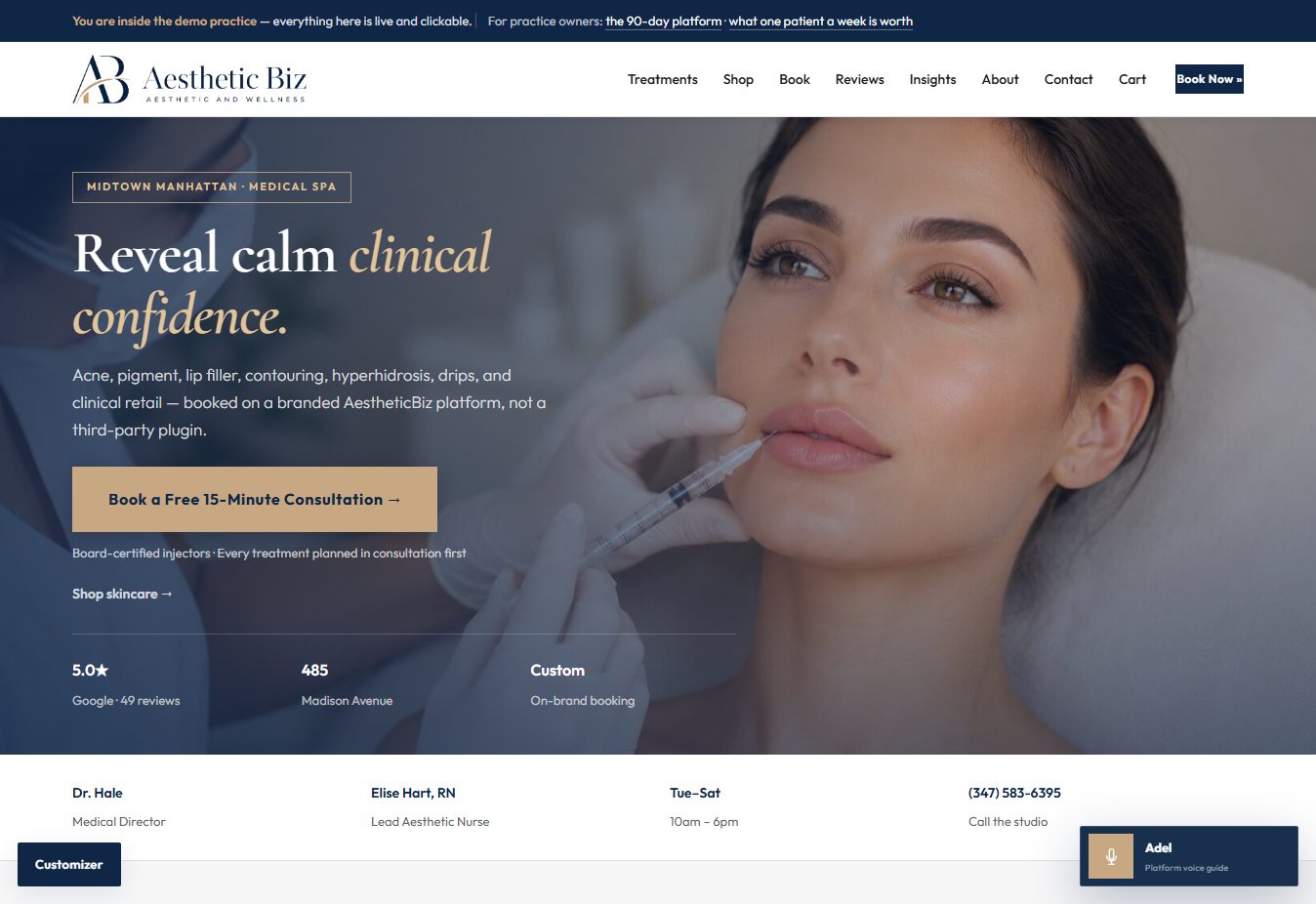
AestheticBiz
A medical spa that books, sells skincare and rewards loyalty on its own brand, ready to launch for a US practice in 90 days.
Questions owners ask
Straight answers.
Will AI replace doctors?+
No. It is taking over documentation, admin and first answers to routine questions. Diagnosis, judgement and the relationship with the patient stay with clinicians, and patients say that is what they want.
Is it legal to use AI with patient information in South Africa?+
It can be, with care. Health information is special personal information under POPIA, so you need a lawful basis, limited access, a known storage location, and providers who do not train on your data. Take advice for your specific use.
Can a practice website use patient testimonials?+
Be careful. The HPCSA’s rules on advertising, canvassing and touting apply online, and it holds practitioners responsible for misleading content. Check Booklet 2 and Booklet 16, or ask the HPCSA, before publishing reviews or before-and-after images.
Are AI scribes worth it?+
For many clinicians they reduce time on notes and mental load, but results vary and errors still occur. Treat the draft as a draft: review it before it is filed.
What is Claude for Healthcare?+
A set of tools Anthropic launched in January 2026 for healthcare providers, payers and health-tech companies, built for HIPAA-regulated settings. Availability and terms differ by region, so check before relying on it in South Africa.
How long does a project like this take?+
Most practice platforms go live in weeks, because the structure is proven. The Discovery Call is where we agree the scope and timeline for your practice.
Sources
Where these facts come from.
- One in four US adults use AI for health advice (West Health–Gallup) — Epocrates, 2026
- The health secret 1 in 5 patients keep from their doctors (Zocdoc survey) — Stacker / KEYT, August 2026
- Anthropic launches Claude for Healthcare — Fierce Healthcare, January 2026
- Claude for healthcare and life sciences — Anthropic, 2026
- Take note: the AI scribe era is here — Medical Economics, March 2026
- AI scribes cut workload but need oversight — HealthManagement.org, 2026
- Protection of Personal Information Act 4 of 2013 — South African Government, 2013
- Booklet 2: Generic Ethical Rules with annexures — HPCSA, current
- HPCSA guidance on AI and social media (Booklet 16 updated March 2025) — HPCSA blog, 2025
Vendor figures are the vendor’s own claims, and survey figures are from the samples named. We update this guide as the industry moves.